
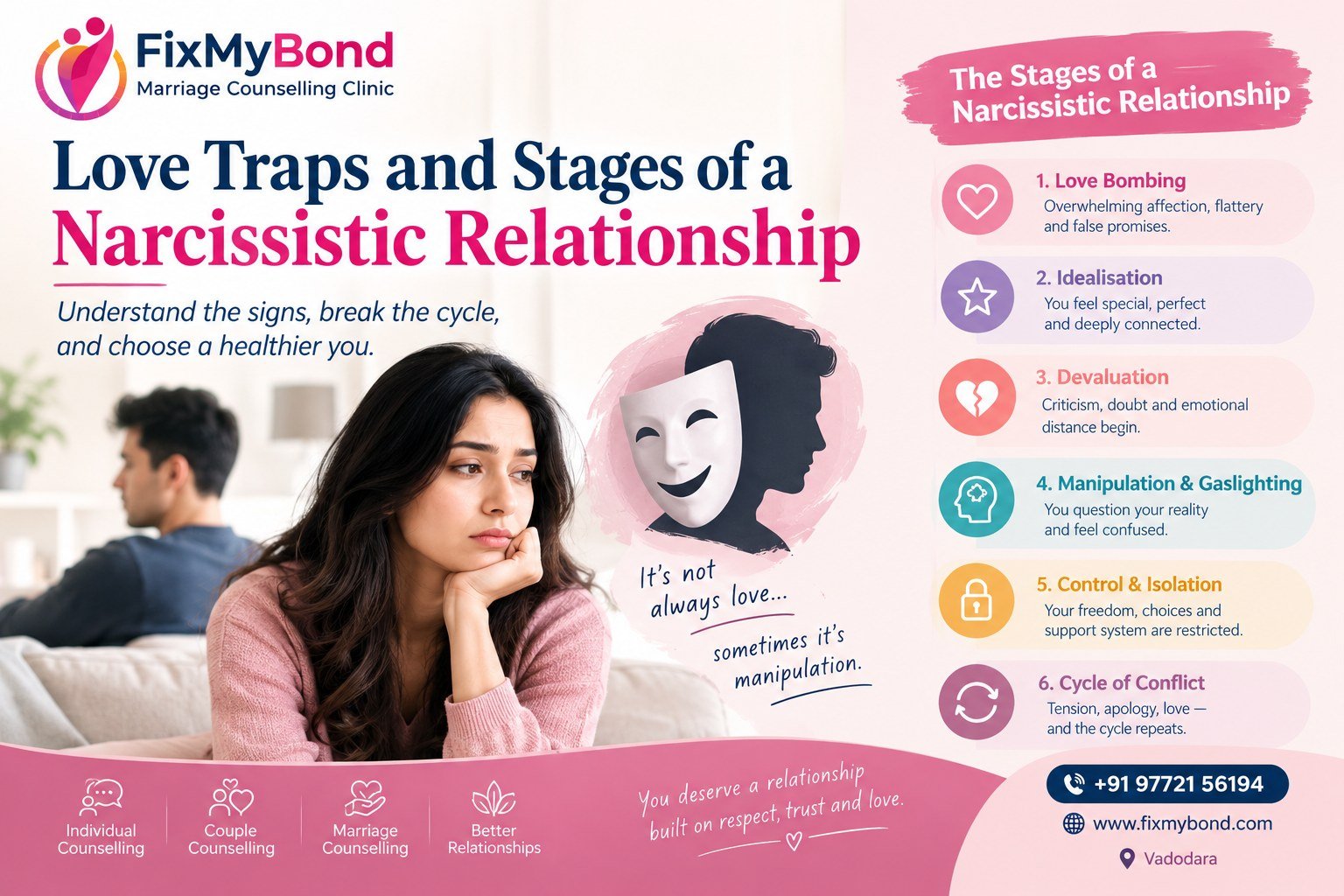
Love Traps and Stages of a Narcissistic Relationship
We can feel appreciated, understood, and emotionally safe when we are in love. On the other hand, some relationships start off with a great deal of affection and eventually get confusing domineering or emotionally draining. It might be challenging to identify what is going on when affection is combined with manipulation, criticism or a persistent craving for control.
People can recognize unhealthy behaviors safeguard their mental health, and make wise relationship decisions by being aware of the stages of a narcissistic relationship.
Relationships involving chronic self-centered behavior a lack of empathy manipulation or a need for admiration are frequently referred to as narcissistic relationships. But not all partners who are challenging or self-centered suffer from narcissistic personality disorder (NPD). That disorder can only be evaluated and diagnosed by a licensed mental health expert.
What Is a Narcissistic Relationship?
An persistent imbalance where one partner’s demands feelings and opinions continuously take precedence over the other’s may be a sign of a narcissistic relationship.
In order to maintain a harmonious relationship a person experiencing this dynamic could believe that they must continually demonstrate their love refrain from upsetting their spouse or give up their own wants.
Typical warning indicators may consist of:
- Excessive attention and affection early in the relationship
- A strong need for admiration or validation
- Repeated criticism, humiliation or belittling
- Blaming others and refusing to take responsibility
- Controlling behaviour or disrespect for personal boundaries
- Denying events or twisting conversations to create confusion
- Using guilt, silence or threats to influence a partner’s decisions
One incident alone does not establish narcissism. It is important to look at repeated behaviour its impact and whether a person takes responsibility and makes meaningful changes.
Stage 1: Love Bombing — When Affection Feels Overwhelming
One often discussed trend is love bombing in which someone gives another person an unusually excessive amount of attention affection praise or commitment early in a relationship.
They may send continuous messages make huge romantic gestures dream about a beautiful future or swear that they have never felt this way about anybody before.
Strong attachment does not always equate to manipulation. When boundaries are disregarded attention feels coercive or affection eventually becomes dependent on compliance and obedience there is cause for concern.
What to look for: Does the relationship allow you to move at a comfortable pace? Can you say no without being punished coerced or made to feel guilty?
Stage 2: Idealization — Feeling Like the Perfect Partner
During the idealization stage the partner may appear to admire practically everything about you. They might describe you as extremely perceptive exceptionally gorgeous or the one person who actually gets them.
This can build a profound emotional bond. You may begin picturing a future together before you have had enough time to understand each other’s values behavior and compatibility.
The warning indicator is not enjoying romance. It is feeling hurried into commitment or being discouraged from retaining friendships interests and independence.
When you argue set boundaries or make decisions on your own, pay attention to how respectfully your partner behaves.
Stage 3: Devaluation — When the Relationship Starts to Change
The initial compliments in some toxic relationships eventually give place to criticism, disparaging remarks comparisons or persistent grievances.
Once-admired partners may start to doubt your skills attractiveness friendships or choices. You may believe that there is nothing you can do to reclaim the love you once felt.
Because you could continuously attempting to revive the previous version of the relationship this stage can be very perplexing.
What did I do wrong? or “Will things return to normal if I strive harder? are some questions you may have.
Though repeated humiliation intimidation and attacks on your self-worth are unhealthy ways to handle conflict, keep in mind that disagreement is natural in partnerships.
Stage 4: Gaslighting and Emotional Manipulation
A process of manipulation meant to cause someone to question their recollections perceptions or comprehension of events is known as gaslighting.
For instance a partner may insist that you are dreaming reject what they have said repeatedly or brush off every worry as evidence that you are overly sensitive.
Guilt-tripping transferring responsibility threatening to end the relationship during arguments and employing silence as a form of punishment are further examples of emotional manipulation.
You can eventually start to doubt your own judgment and depend more on your partner to determine the truth.
Keeping in touch with trusted individuals keeping an eye out for recurrent patterns and getting an unbiased opinion from a licensed counselor or mental health professional are all beneficial steps.
Stage 5: Control, Isolation and Loss of Independence
One partner may progressively try to control the other’s friendships money clothes job daily schedule or access to family in a controlling relationship.
You may believe that every contact needs to be explained in order to prevent conflict or that you require permission for everyday decisions.
Because you have fewer opportunities to talk about your experiences with people you trust isolation can make evaluating a challenging relationship more challenging.
Both parties can preserve their identities relationships and appropriate privacy in healthy partnerships.
Speak with a trusted individual or a professional support service if you are subjected to threats intimidation surveillance or limitations on your freedom. Make safety plans before confronting your partner or trying to leave if you are afraid of reprisals.
Stage 6: The Cycle of Conflict and Reconciliation
Certain problematic relationships have a recurring pattern: after a painful event tension rises, then the partner subsequently apologizes shows affection or makes a commitment to change.
There may be real relief and hope as a result of this reunion. However the cycle may persist if the same detrimental behavior keeps happening without responsibility or long-term change.
When an apology incorporates accountability respect for limits and persistent behavioral changes it has the most impact.
A partnership does not have to be evaluated solely on the basis of its best times. Think about the general trend and your typical mood.
Why Is It Difficult to Leave a Narcissistic Relationship?
It might be difficult to end an emotionally damaging relationship. You can still be in love with your partner think back on the good times worry about kids or money or hope that they will change.
Frequent criticism can also erode confidence making it more difficult to have faith in your own judgment. If the partner acts differently in public friends and family could not comprehend the issue.
You are not weak because of these challenges. Relationship decisions can be difficult due to dread of the unknown, practical obligations, and emotional attachment.
Instead of blaming yourself for what has occurred try to concentrate on your safety, emotional needs and accessible assistance.
How to Protect Your Emotional Well-Being
Take into consideration the following actions if you identify unhealthy habits in your relationship:
1. Take note of recurring behavior. Instead than depending just on assurances or sporadic positive experiences, consider trends over time.
2. Establish safe boundaries. Describe the behaviors you will not tolerate and think about what you can do if they are disregarded.
3. Keep up reliable relationships. Maintain relationships with people who value your independence and can provide you with emotional or practical help.
4. Regain your self-assurance. Make space for your hobbies objectives habits and choices. To help you organize your thoughts think about putting your worries in writing.
5. Get expert advice. You can examine the connection comprehend its emotional effects and think through your options without feeling pressured by individual counseling.
Make safety your top priority and get in touch with emergency or specialized support services if you feel uncomfortable are threatened or are the victim of physical or sexual abuse. Couples counseling might not be suitable in situations where open communication is dangerous due to abuse or coercive control.
Can Relationship Counselling Help?
Relationship counseling can assist individuals in comprehending dysfunctional relationship patterns communication issues trust issues and recurrent conflict. The appropriate kind of assistance however varies depending on the situation.
For someone who is confused emotionally spent or uncertain about what to do next individual counseling could be a helpful place to start. It can offer a place to examine one’s own limits feelings and decisions.
When both couples are able to freely and safely participate acknowledge their behavior and strive for change marriage counseling or couple therapy may be beneficial. An individual evaluation and expert assistance should be the initial steps in cases of abuse intimidation or coercive control.
How FixMyBond Can Support Relationship Well-Being
Through counseling services tailored to their needs individuals and couples can examine relationship issues communication difficulties and marriage-related hurdles at FixMyBond Marriage Counseling Clinic.
Professional advice can help you understand your options and determine the best course of action if you are experiencing emotional distance frequent disagreements trust issues or relationship instability.
You do not have to terminate a relationship or remain in one in order to get treatment. You should have the chance to talk about your worries comprehend your situation and make choices that protect your health and safety.
Final Thoughts
Love bombing idealization devaluation manipulation and cycles of conflict and reconciliation are frequently used to characterize the stages of a narcissistic relationship. Real relationships however do not always follow a set pattern and personality disorders can not be diagnosed by these patterns alone.
Whether the partnership continuously respects your independence limits dignity and emotional safety is what counts most.
Love should not force you to give up who you are or constantly worry about what other people will think of you. A better future may be achieved by identifying detrimental patterns and seeking out the right kind of assistance.